
D1, D9 and D10: A Divisional Chart Comparison Checklist
16 November 2026
When the birth chart looks encouraging but a divisional chart shows a difficult placement, the useful question is not “Which chart should I ignore?” It is “What does each section actually show, and how reliable are the birth details?” Astrometry’s Divisional Chart Readings Software derives multiple charts from one birth-data form and displays placements, dignities, yogas, Lagna reasons and rule-matched passages. This checklist concentrates on comparing D1, D9 and D10 without turning one isolated label into a final prediction.
Give each chart a clear job
The supplied report rulebook describes D1 as the birth chart that provides the overall context. D9, or Navamsa, covers marriage and spouse, dharma and the inner strength of planets. D10, or Dashamsha, focuses on profession, honours, promotions or demotions, income through self-effort and the trend of work.
These are traditional domains, not separate scientific tests. A D10 passage should not be treated as a marriage verdict, and a D9 placement should not erase the birth chart. Begin with the subject of the consultation and then read the relevant divisional evidence alongside D1 and the running dasha.
Use one consistent set of birth details
The software calculates the source chart once and derives the divisional placements from its longitudes. You do not enter a different birth date or a new set of planet positions for each varga. Check the recorded time, date, place and calculation settings before building the report.
A change in birth time can alter the ascendant and divisional house placements. Do not use a universal “safe number of minutes” for every chart and location. If the recorded time is uncertain, state that uncertainty rather than making a fine chart look precise. For a structured review of recorded life events, see the Birth Time Rectification software and our birth-time preparation guide; a preferred prediction is not evidence for choosing a time.
Compare evidence in the same order
- Domain and Lagna: confirm the chart code, its subject, the Lagna sign and the displayed strength verdict.
- Placements: follow the same planet through D1, D9 and D10. Record its sign and whole-sign house separately for each chart.
- Dignity: note the actual label shown, such as exalted, own, friend, neutral, enemy or debilitated. Dignity is one item of evidence, not the entire reading.
- Conjunctions and house significations: review the companions and meanings printed in that chart’s placement table.
- Yogas: read the detected combination and its detail. A named yoga should be tied to the chart in which its conditions were detected.
- Prediction passages: keep the positive, negative and note tags attached to their text, and check that the passage belongs to the chart being discussed.
You can use the Divisional Charts calculator for a visual chart comparison and the readings software for the accompanying rule-based report. The visual chart and the narrative answer related but different questions.
A comparison worksheet without invented scores
For each planet relevant to your question, make three short entries: “D1: sign, house, dignity”; “D9: sign, house, dignity”; and “D10: sign, house, dignity”. Under each, record the applicable yoga details and matched passages. Then add the Lagna verdict and its reasons for that chart.
This is a way to organise what the report already says, not a new formula. Do not convert positive and negative tags into a percentage, add your own weights or call the number a success probability. The software’s displayed evidence should remain distinguishable from your interpretation.
What to do when the charts disagree
First check whether the apparent disagreement concerns the same planet, life area and type of evidence. A supportive dignity label and a difficult house-related passage need not be statements about the same thing. Next, read the Lagna reasons and yoga details rather than relying only on a summary word.
Keep both observations in the consultation notes. The engine does not invent an explanation to reconcile every tension, and an article should not supply a new rule that the software never used. Where the report gives mixed evidence, a qualified reading should preserve that nuance.
For a profession-focused consultation, the Career Report is a separate workflow. Our Career Report guide explains its own D1/D10 and timing sections; do not assume every result or scoring method is interchangeable with Divisional Chart Readings.
Missing passages are not negative predictions
The local engine selects passages when their supplied conditions match. If a condition does not match, the absence of its text is not an automatic denial of an event. Likewise, a displayed “note” is not necessarily an unfavourable result. Read what is present without filling gaps with an invented interpretation.
Keep timing separate from placement evidence
A divisional placement describes evidence within that chart; it is not by itself an event date. The report’s supplied disclaimer asks readers to consider every varga with the birth chart and running dasha. Use the Vimshottari Dasha calculator for a separate period view, keeping the same birth details and settings. Neither a single dignity label nor a yoga name establishes a guaranteed promotion or marriage date.
Why not jump straight to D60?
The software also includes finer divisions such as D60, but finer resolution does not make uncertain input more trustworthy. If the time is approximate, explain that limitation before using finer house placements to support a conclusion. D1, D9 and D10 are a focused comparison workflow, not a claim that other vargas are unimportant.
Before downloading or sharing
- Confirm the name and birth details shown in the report.
- Check the chart count and keep each chart’s labels with its evidence.
- Preserve Lagna reasons, yoga details and tagged passages rather than sharing only a verdict.
- If selecting a non-English PDF, review the machine-translation disclaimer and refer to English for precise wording.
- Record any birth-time uncertainty with the report, and avoid guarantees about marriage, employment or income.
Frequently asked questions
Do I need to enter D9 and D10 separately?
No. The software derives them from the same calculated source chart.
Does one negative passage cancel the entire chart?
No single passage supplies that conclusion. Read its scope alongside placements, yogas, Lagna reasons and the rest of the matched text.
Can a chart guarantee a career outcome?
No. These are traditional interpretations for study, not statements of fact, employment advice or promises.
Build a Divisional Chart Readings report, explore the birth-chart reading guide or compare software access on the pricing page.
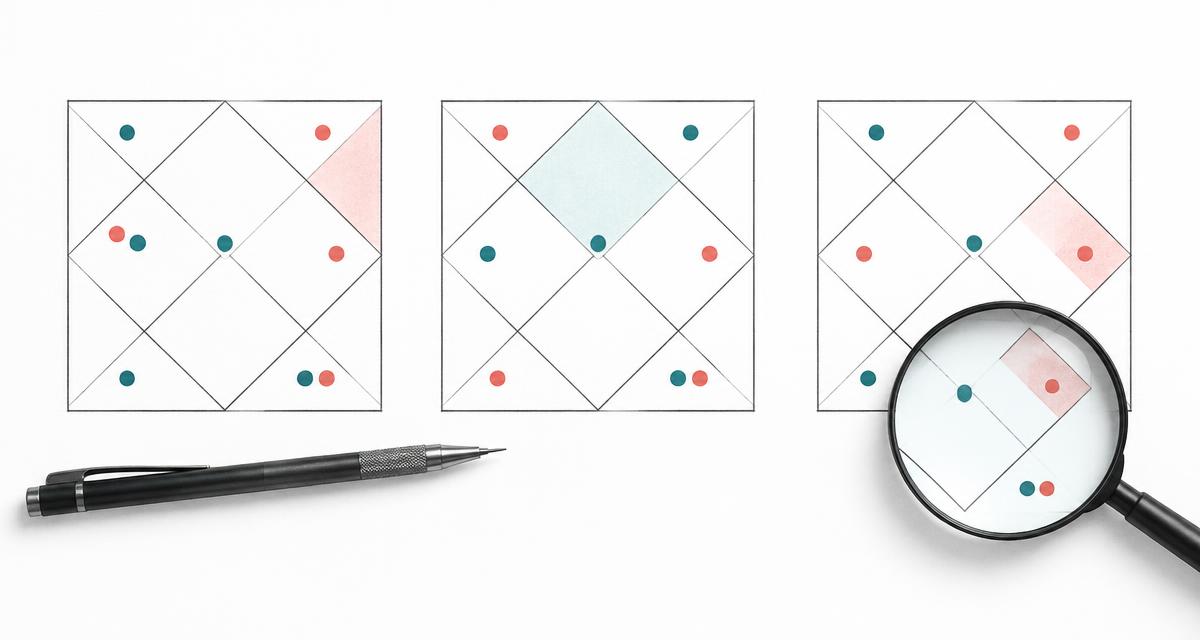
For the complete product overview, read our Divisional Chart Readings software guide. The illustration above is conceptual, not a calculated birth chart or prediction.