
Past Life Karma Software: Jeeva Charts, Karma Account and Timing
23 November 2026
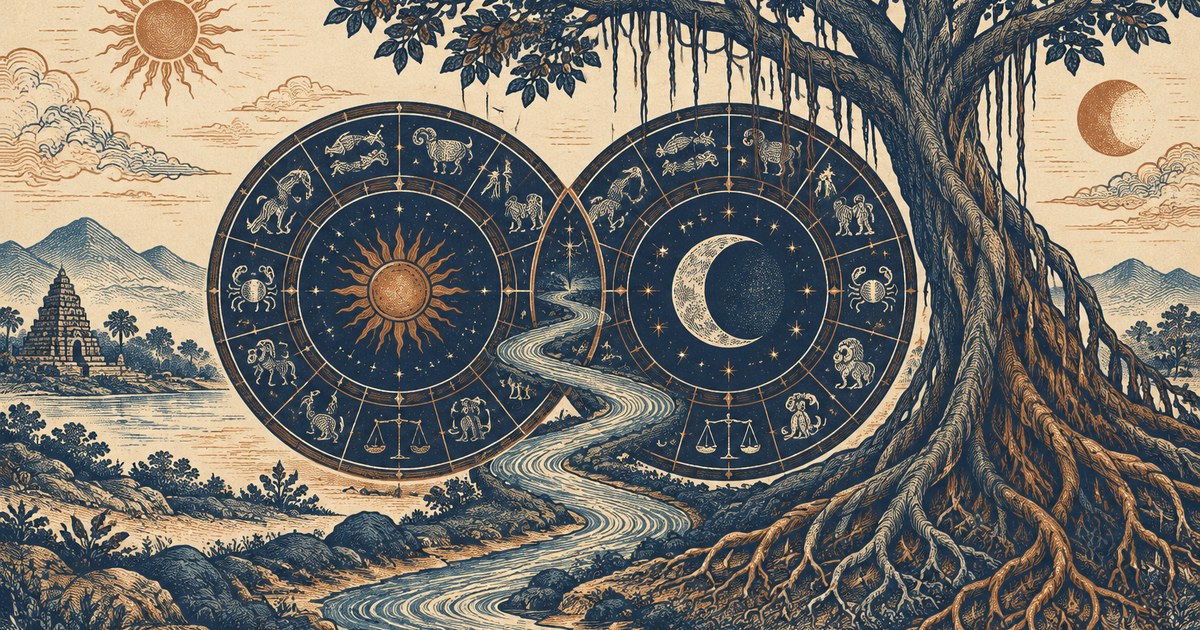
The Past Life Karma Report is a detailed symbolic reading built around a reconstructed past-life horoscope, Jeeva charts and a karma account. Its size becomes easier to navigate when you separate the chart calculations, the interpretive narrative and the sections that depend on a reading date.
Astrometry’s Past Life Karma software generates the report locally from its supplied calculation and narrative rules. A reconstructed horoscope is not a recovered historical record or evidence of a literal biography; use the report as a framework for astrological reflection.
1. Enter both birth data and a reading date
The birth date, local time, coordinates and UTC offset determine the horoscopes. Selecting a city fills the place fields, or you can type the values yourself. For births affected by war time or daylight saving, enter the offset that was actually in force. The software also cautions that latitudes beyond ±66° make the ascendant unreliable.
The reading date is separate. It controls the current-transit material labelled “as of” that date. Leave it as the default for a present reading or set it deliberately when reviewing another date, and keep that date visible in your notes.
2. Understand the four horoscope views
The horoscope section includes the present-life chart, the reconstructed past-life chart, the present Jeeva chart and the future-life Jeeva chart. North and South Indian display options change the visual presentation, not the underlying calculation.
Begin with the present chart before moving into the reconstructed one. This gives you a fixed reference for planetary positions and houses. The Jeeva charts belong to the report’s own karmic framework; they should not be confused with a second birth record or with ordinary transit charts.
3. Read the karma theory before the predictions
The opening theory explains the report’s understanding of karma, its types and how karma gives results. Those passages establish the vocabulary used later. Reading them first helps prevent a challenging line in the predictions from being interpreted outside the model’s stated framework.
The key predictions then apply that framework to the reconstructed chart. Treat them as interpretive statements within the supplied tradition, not as verifiable memories. If a passage raises distress or a serious present-day concern, ground your response in current facts and appropriate support rather than trying to infer a literal past event.
4. Use Saturn as the entry to the Karma Account
The Karma Account begins with Saturn as lord of karma, showing its sign, house and retrograde status before the associated reading. The account then presents separate karmic entries with their own types and tones. Read the complete entry instead of isolating a single difficult phrase.
Saturn’s placement is one organising element, not a verdict on a person’s worth. The later challenge areas, house-by-house material and planet-by-planet comparisons show how the report develops related themes across different life areas.
5. Separate Dridha, Adridha and karmic-yoga timing
“When Your Karma Ripens” brings together several timing layers. The Dridha section lists the Mahadasha timeline, the current period and, where applicable, the current Antardasha. This is the dasha-based part of the reading.
The Adridha section uses the selected as-of date for gochar material, including transit readings and the displayed Sade Sati note. The following karmic-yoga area discusses applicable combinations and states when results follow dasha and transits more directly in the absence of major listed yogas. These are related sections, but they are not interchangeable clocks.
For an independent view of the period sequence and present positions, use Astrometry’s Dasha and Transit tools with consistent birth settings.
6. Trace themes through retrogrades and Rahu-Ketu
The house-by-house past-life horoscope, “Each Planet: Past Life → Present Life,” and life-area comparisons are best read together. They show how the report carries a theme from the reconstructed chart into present-life interpretation. Special challenge areas identify where the supplied rules emphasise effort or unfinished work.
Retrograde sections discuss pending karma, combinations and Saturn’s three-chance framework. The Rahu-Ketu chapter describes the karmic axis through each node’s sign and house. Keep the distinction: Ketu and Rahu are being interpreted as an axis within this model, not as literal proof of a former identity.
7. End with guidance, not fatalism
The future-life and guidance sections bring the narrative back to how the report suggests settling or working with past-life karma. Use the closing reflection to identify a constructive theme you can think about in the present rather than treating the report as a fixed sentence.
If you specifically want traditional chart-based, problem-specific or current dasha-and-transit practices, the Remedies software is structured for that purpose; our Remedies report guide explains the difference. You can also compare all three newest reports in this selection guide.